In honour of Biomedical Science day 2021, I reached out to the Biomedical Science Community to host interviews with Biomedical Scientist’s in different disciplines. My aim is to raise awareness of what Biomedical Scientist’s do in different disciplines
My second interview is with Chelsea Palmer Biomedical Scientist at York and Scarborough Hospitals NHS Foundation Trust
So everyone sit back, grab a cuppa and happy reading!!
So, Chelsea can you tell me what your favourite subject was during school?
“My favourite subject at school was actually Spanish! With Science and English being a close second and third (apart from Physics!!).”
What would you say is your favourite movie?
“Oooh, difficult one. My favourite movies (joint top) are probably Dogma and Who Framed Roger Rabbit. I love films and worked in a cinema whilst studying my degree.”
How did you begin your career in biomedical science and what inspired you to work in Biomedical science?
“I actually began my career, post degree, within a Contract Research Organisation called Covance, I then went to work for a research team within the University of Leeds and finally got my job in the NHS, 3 years later! I have always wanted to work within the healthcare environment and so Biomedical Science combined both my love for science and helping others! Cheesy, I know!”
So, Chelsea,what discipline do you work in and is it a big department?
“I work under the umbrella of Cellular Pathology which in our directorate of Laboratory Medicine, encompasses Histopathology, Cytopathology and Andrology with the last two being in the same laboratory and Histology living upstairs.”
Can you tell me what Andrology and Cytopathology is?
“Cytopathology is the examination of cells within fluid specimens to diagnose malignancies such as cancer.
Andrology is the examination of seminal fluid samples (spermatozoa) both for fertility issues and after vasectomies.”
What is the difference between Andrology and Cytopathology and do you have a favourite discipline to work in?
“Quite a lot is different about the two disciplines, not all cytology departments undergo andrology work, it could be within any department in laboratory medicine. Andrology is looking at mens reproductive systems whereas cytology looks at fluid samples for cancerous changes. Cytopathology in some places houses the cervical screening programme too which screens ladies smears for pre-cancerous cells.
I don’t have a favourite as both are so different from each other and come with their own challenges. I am also trained in Histology so it’s nice to have a variety.”
In your discipline, how are tests carried out?
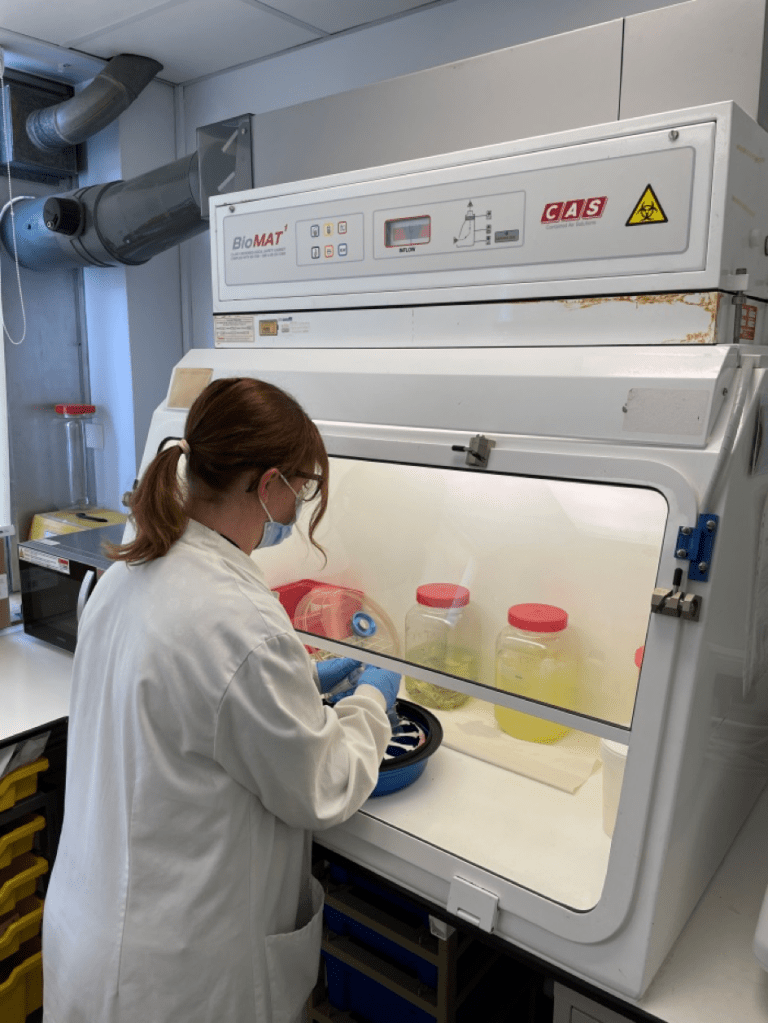
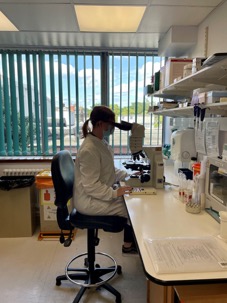
“In Cytology, all of the fluids are prepared into glass slides, stained and analysed by our consultant histopathologists.
In Andrology, we screen the vasectomy samples for the absence of sperm and for the fertility samples, we look at the motility of the sperm (whether they’re moving or not), how many of them are there (the count) and what their morphology looks like (whether they are an abnormal shape or not).”
Can you describe what a typical day/ week is like for you?
“A typical day or week is so varied in my department. We can get up to 30 andrology samples in a week which all have to be booked in in order for them to be screened in the appropriate time (they are time sensitive samples). Cytology is very varied, some weeks we can have lots of samples, others not many. Samples vary from serous fluids like pleural effusions, breast aspirates to urines. All of them treated slightly differently but the end product is the same. The work is admixed with a lot of paperwork for quality control, auditing and reporting!”
Can you tell me what your favourite thing about your career?
“My favourite thing is knowing there is a patient at the end of every sample and what you are doing is helping to diagnose their issues.”
What motivates you to work hard?
“I find I’m quite a hard working person naturally, I like everything in order and done to the best of my ability but I think what motivates me to work the hardest is to ensure that all of the samples are processed to the best standard and as quickly as possible.”
What are the greatest challenges you faced during your career?
“I’m currently undertaking my Specialist portfolio with the IBMS so at the moment I would say that. In the past, I’d say my greatest challenge was getting to where I am now in the NHS. When I graduated, there weren’t many jobs within the NHS so the competition was quite high. Now I feel like that challenge was a good thing as I gained more experience elsewhere and it solidified my desire to work where I am now.”
Are there any current issues and trends in this field that we should be aware of?
“There aren’t really that many issues and trends in Cytology and Andrology with them being qualitative testing rather than quantitative. The main things that are being looked at are digital pathology for Cellular Pathology as a whole and Molecular Pathology. These are the directions in technology that laboratory medicine as a whole seems to be heading. Andrology doesn’t really change too much however the hot topic seems to be retrograde ejaculation at the moment which only bigger clinics can currently deal with.”
What has been your most successful post and what made it successful to you?
“This post I’m currently in, I’ve been here nearly 5 years now and I’ve done a diploma in cervical screening and am undertaking my specialist diploma/portfolio. However, I did co-author a paper in my last job which made me feel quite successful.”
Do you feel like you’re making a difference in your job?
“Yes, without the NHS laboratories, over 70% of diagnoses may be missed. However, I do feel like we are unsung heroes. The press around COVID19 has shed a bit of light on the laboratories but mainly the ones testing for it.”
What skills would you say are the most crucial in succeeding in this career field and what type of person do you need to be?
“I think the most crucial skills are time management, a willingness to learn and the ability to communicate with a range of people. You definitely need to be a person that cares but is also able to disassociate yourself from the patient. It’s a very hard job if you become attached to the patient, so unfortunately you have to be able to distance yourself and see samples as just that but also remember there is a patient at the end of it.”
How does your position fit in within the biomedical science field?
“As a Biomedical Scientist I have members of staff under me (Medical Laboratory Assistants) and senior Biomedical Scientists and Consultants above me. I am working towards being a specialist Biomedical Scientist. Within our directorate, Cytology/Andrology is part of Cellular Pathology with the Histology department. We work alongside Microbiology and Blood Sciences in order to diagnostically test and screen for diseases, disorders and malignancies.”
Do you have any advice or tips you would give to the future generation interested in working in a laboratory setting?
“Research what degree you want in relation to the job you feel like you wish to go into. Certain jobs require registration (like in the NHS) and to get there, you need to have an accredited degree and then a registration portfolio. Gain some experience or even a walk around some labs, it’ll help and lastly, don’t let anything put you down. If you are meant to be in the lab, you’ll get there somehow.”
If you could do it all over again, would you choose the same career for yourself? If not, what would you change?
“Yes, I wouldn’t be where I am or who I am if I didn’t go through the things I did. If I changed anything it would have been to go into Histology rather than Cytology but that’s hindsight due to the constant changes in contracts for Cervical Cytology.”
And finally, what does being a biomedical scientist mean to you?
“Being a registered healthcare professional means a lot. Biomedical Scientist is a protected title which I think is quite special in itself. I love being a biomedical scientist and though I’ve worked in a few of the different fields of Biomedical Science, I feel like I am helping others and feel most at home in the NHS in diagnostics.”
A special thanks to Chelsea for allowing me to interview her. I hope this post showed everyone what an amazing job the Biomedical Scientist’s team does in Cytopathology and Andrology. I hope this post has given those who didn’t know what a Cytopathology and Andrology Laboratory is a chance to see what happens behind the scenes.
Give Chelsea a follow on Twitter: @Chelsea_Palmer to see how her work continues
Thank you for taking your time in reading this post, please leave a comment and subscribe.

 A Muggle's Laboratory
Leave a reply to muneebahj Cancel reply